
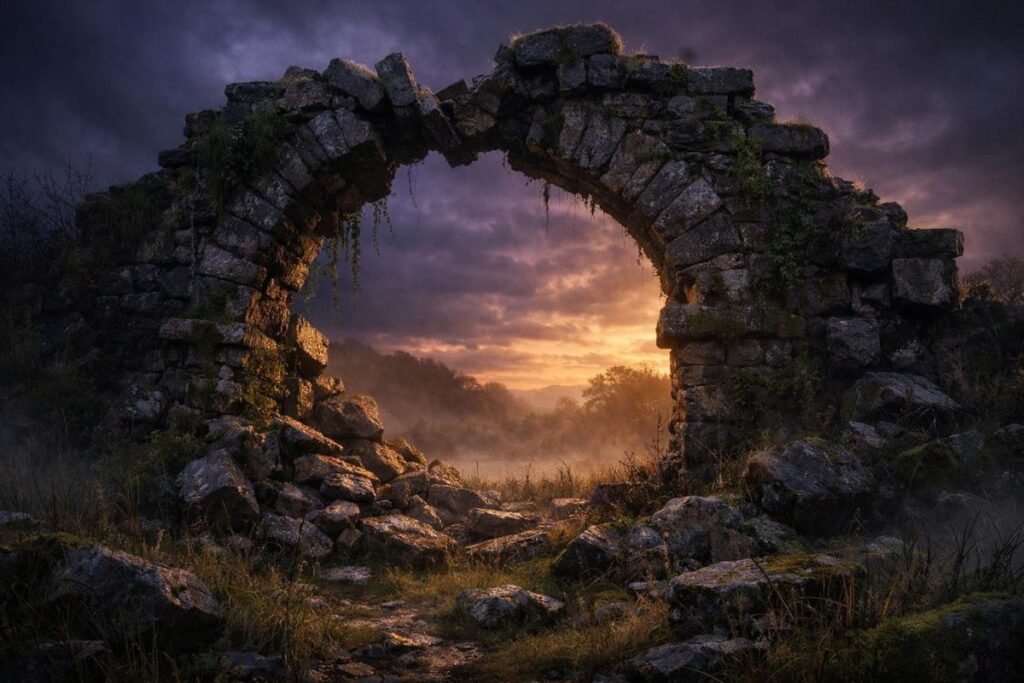
Every culture that looked into the dark long enough came back with the same story. A place beside this one. Not above it, not below. Beside.
The Celts called it the Otherworld. The Portuguese and Galicians knew it as the Mourama. At Disney they call it Fairyland. The map underneath the names is identical. Not a myth or a metaphor, a place with weight and weather and a specific quality of light.
I’ve been close enough to the border to see.
The light is the first thing. It doesn’t come from anywhere you can identify. Something that predates the distinction. Colours glow true. Unfiltered.
Beautiful, yes. But beauty that sure of itself can be dangerous.
Time doesn’t move in any way you could measure, there. Not faster or slower. More like it moves sideways. You surface and the world has continued without you, indifferent to the gap.
Get close to this landscape and you are aware of being watched. Not hostile. Just—noted. The place knows you’re there the way old forest knows you’re there. It doesn’t need to do anything about it. And it won’t.
Unless you do.
The details that repeat across traditions are the ones that give the most.
Calendars that intersect with ours at fixed points. Solstices. Specific feast days. Dates that older traditions marked with fire or water or deliberate stillness. On those days passage was possible. The enchanted could surface. The trapped could call out. The gate, briefly, was negotiable.
It has rules. You could enter wrongly and not return. You could be held—not by force but by contract. A bite of food, a spoken word, a debt incurred without knowing. Across a dozen cultures and a thousand years the rules held consistent. Some call it superstition. But it’s more about the terms and conditions that nobody this side thought to read.
It has marked borders.
Stones, mostly. Arranged or solitary, placed at entrances, at crossroads, at the edges of water. Not decorative. Functional. The markers said: here the boundary holds. Every tradition that described the other world also described its gates, and every gate had a keystone. Something that held the structure. Something that if removed didn’t just open the gate.
It brought the gate down.
Something more to note.
If the gate has a keystone, someone placed it. If it runs on a calendar, someone set the terms. If the rules are consistent across a thousand years and a dozen cultures, something is maintaining them.
Infrastructure doesn’t maintain itself.
And when a gate comes down—not opened, not negotiated, but destroyed—something on the other side is left without a door.
I know someone. Long way from where she started. Been looking for stones for longer than most people have been alive.
She doesn’t talk about what she’s looking for. But she talks about what’s missing. Home. Family.
Learn from her. Read Skye Quest.
The point is this: if you took something that marked a boundary—a stone, a lintel, a carved threshold pulled from its place because it looked valuable or interesting or because someone paid you to—don’t be surprised if something comes looking for it.
You won’t get a warning.
It won’t be asking politely.
It will just take it back.

To read the books mentioned in this post, go to:


