There’s a soul cake on the bar.
Small thing. Flour, butter, spice, a few currants. A cross cut into the top deeply enough to survive the oven.
You could mistake it for a biscuit.
Soul cakes belonged to Hallowtide: All Hallows’ Eve on 31 October, All Saints’ Day on 1 November, then All Souls’ Day on the second. Dates shifted in practice. Custom continued. In parts of England, soulers went from door to door during the season asking for food, drink or money.
In return, they prayed for the dead.
Sometimes one cake meant one soul remembered. Sometimes the prayer was intended to ease a soul through Purgatory. Later, children took up the rounds. In some places they carried lanterns cut from turnips, little lights inside pale heads.
Nothing unsettling there.
You’ll be told souling came from Samhain. You’ll also be told it became trick-or-treating. There’s truth in the vicinity of both claims, I suppose. Customs cross borders. Churches adopt them. Children improve them. Migrants carry fragments overseas, where those fragments meet other fragments and become something apparently new.
Historians need clean lines. Traditions are rarely so considerate.
The core survived: a person came to the threshold and received something in exchange for work performed on behalf of the dead.
A transaction.
Souling may be termed charity, community or remembrance. It was all three, and feeding someone before winter is reason enough to keep any custom alive.
But its structure is a bargain ritual.
The house gives food. The souler accepts it. A prayer is then owed and directed towards the household’s dead. Payment, obligation, named beneficiary. The important parts are all there.
Food for prayer. Prayer for passage. One thing promised in return for another.
But people become careless when a bargain involves baked goods—or sweets.
No one explains the terms.
Currency doesn’t decide whether an agreement has weight. The terms do. The shape of the exchange was old long before that child turned up at your doorway calling, “Trick or treat.”
Call it folklore if that makes it easier. Folklore is where people put rituals after they’ve forgotten what the rituals were for.
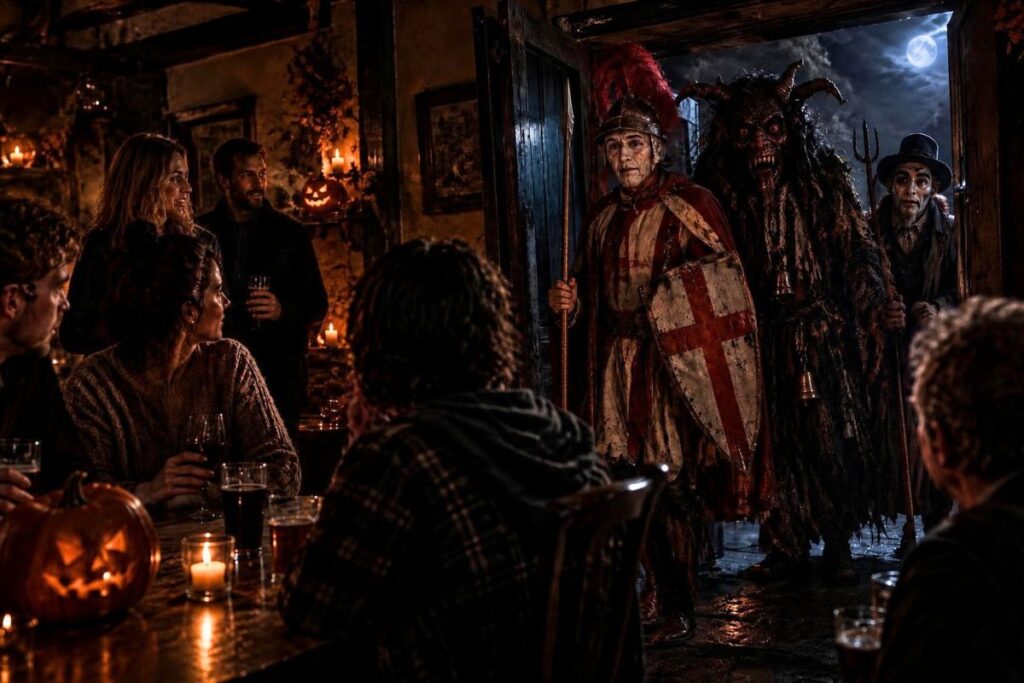
In Cheshire and the surrounding country, souling acquired—or retained—another form. Groups of soulers went from house to house and pub to pub performing short mumming plays. Versions differ, but the bones are familiar.
A hero enters. Often St George.
An opponent challenges him. Sometimes the Turkish Knight, though names and allegiances shift according to village, memory and whichever costume still fits.
They fight. One dies.
Then the Doctor arrives.
He boasts about his travels, produces a cure of doubtful medical value and raises the dead man. Death is reversed. The company celebrates. A hobby horse may force its way into proceedings, because English folk tradition knows when a resurrection requires a horse in someone’s front room or pub lounge.
And somewhere among them comes Beelzebub—or a demon by another name—carrying a club and something suitable for collecting money.
The Antrobus and Lymm Souling Plays are still known in Cheshire. Performances continue. You can watch one here, if you’d like to see what old ritual looks like after it has learned to order a pint.
Most accounts call these death-and-resurrection plays.
Fair enough.
I’m more interested in who collects at the end.
The hero fights. The victim falls. The Doctor brings him back. Everyone watches the miracle.
Then the dark figure takes payment.
If that arrangement sounds familiar, look back through the Author’s books. I can think of at least three figures in them who understand what a bargain can achieve. Don’t look at what they call themselves. Look at the terms, and at who collects when those terms are met. Or broken.
Folklorists will offer readings of Samhain, soulers, mumming plays. Winter dies and spring returns. The crop is cut and grows again. Christian resurrection sits over older seasonal patterns. Young men make noise, drink ale and collect money at a time when both were welcome. Entertainment.
None of those explanations is wrong.
But consider what the same performance at each threshold becomes. A death. A return. A collection. Then onwards to the next house. Do that often enough and it stops being entertainment.
It becomes a way in.
And if the occupants don’t understand the elements of the ritual bargain they made or they leave it incomplete, well…
Perhaps that is part of the ritual’s purpose when it works: not to prevent darkness entering, but to give it terms for leaving.
Since the Risings, the supernatural (as humans call it) has become more desperate. Old words carry further. Old boundaries are under strain. Repeat an action with enough people, on the same night, with the same expectation, and something notices.
So that’s my argument—in case you’ve been too stubborn to listen, or I’ve had one whiskey too many to make myself clear.
Souling preserves a struck bargain inside a piece of folklore. The plays show darkness entering under agreed terms, taking payment and leaving. The masks make it impossible to know whether every performer is human or if every visitor leaves.
That doesn’t mean the children at your door are conducting a rite.
Probably.
But just to be sure: if soulers come to your door, give them the damn soul cake. Coin, sweets, whatever the custom has become where you live. They’ve knocked, you’ve answered and anything may be standing behind those masks. Why risk finding out which of you still understands the bargain?
If they offer a prayer in return, listen closely. Make sure they say who it is for.
Say goodnight, thank you, then check who is left behind.

To read the books mentioned in this post, go to: