There are objects that accumulate invisible history the way wood accumulates rings. To understand, you have to know what you’re looking at.
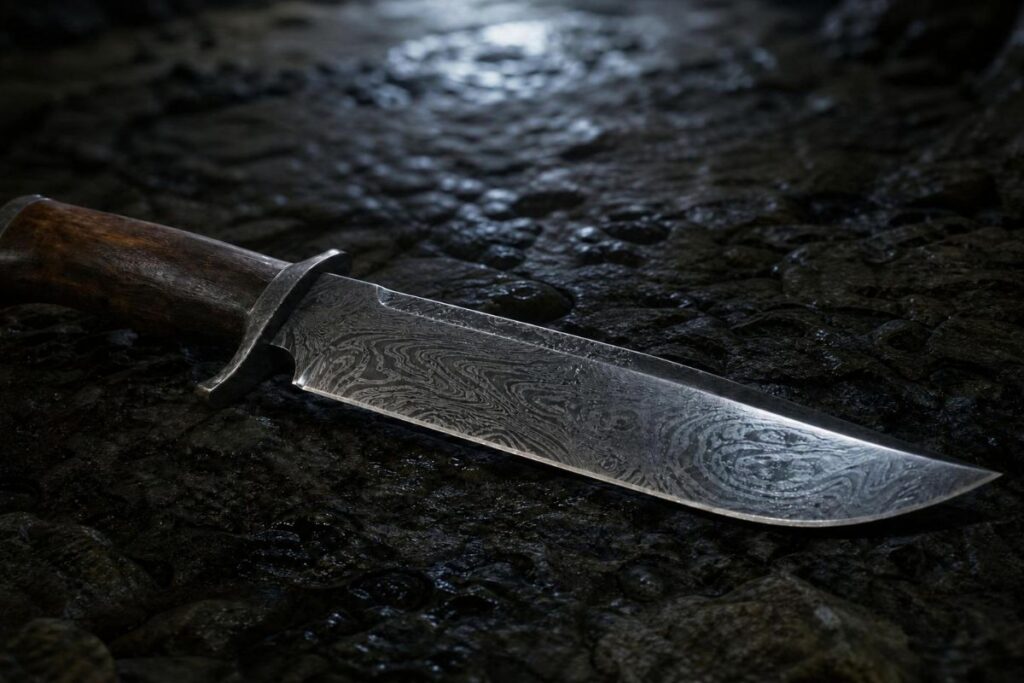
The knife is a Bowie. Heavy. Always sharp. Forged from layered Damascus steel—the dark, swirling waves of the metal chosen as much for its flexibility as its ability to swallow the light. Important in her line of business. The handle is ordinary waxed wood. Comfortable to her grip.
Tazia Savoy has carried variations of it for most of her life. But this one is particular. The one she chose herself, from a basement shop near London’s Oxford Street. A city she was passing through on her way to becoming something her father had not planned for.
She took her time choosing it.
That matters. Tazia does not take her time with most things. But for this weapon, she walked the counter twice. Picked up three. Tested the balance of each in her palm, the weight, the pull of it. Practiced the draw.
Her tattoos, I’m told, were delighted.
That detail stays with me. The ink that bound her—that caused her more grief than most things in her long life—aligned completely in the presence of the right blade. The one moment of agreement between Tazia and the magick written into her spine.
The knife didn’t care what she was. Vampire or human, demon or girl. It simply fit.
Objects that choose their owners should be noted.
And this one did.
This one has been through considerable history since that basement. It has been present at moments I won’t detail here. Read the books for those. The Author has written them faithfully, but I will say that a blade accumulates the memory of what it has and hasn’t done.
There was a moment, toward the end of the events in Detroit, when the knife was not in her possession. It had been retrieved from a cave floor by someone who had no business being tender about anything. He considered using it for a task so far beneath what the knife was made for that he put it back before the thought fully formed.
Not for this.
He cleaned it instead. Returned it to her.
The weight in her hand was a homecoming.
I won’t improve on that. She said it better than I could.
I’ve watched Tazia Savoy navigate a world that has tried, consistently and creatively, to own her. Her father. The ink. The angel. The various forces that saw in her something useful and moved accordingly.
She has relationships. Complicated ones. She trusts a few people—not many, and no one entirely. That’s not a criticism. That’s just an honest accounting of a life spanning one hundred and fifty years.
But the knife is different.
The knife has never lied to her. Never had an agenda. Never tried to use her freedom as leverage or her loyalty as currency. It simply does what it was made to do, in her hand, on her terms. Never fails. When it was gone she was still capable. Still dangerous. Still Tazia.
Just not quite whole.
There’s a version of that observation I could make about people too. About what it means to find the thing—or the person—that makes you whole without making you smaller. But I don’t do that kind of writing, and the knife deserves better than being used as a metaphor.
It’s an artifact. A real one. With weight and history and a waxed handle worn smooth in exactly the right places.
I remember the cities. The rain. The decision she was building toward, slowly, over years, one small act of refusal at a time. Watching.
The knife came later. But it came from the same place that decision did.
Hold tight to your freedom. Never stop chasing it.
She hasn’t. She won’t.
The knife is proof of that.
(Read about the knife’s origin story in Bleeding Ebony.)

To read the books mentioned in this post, go to: