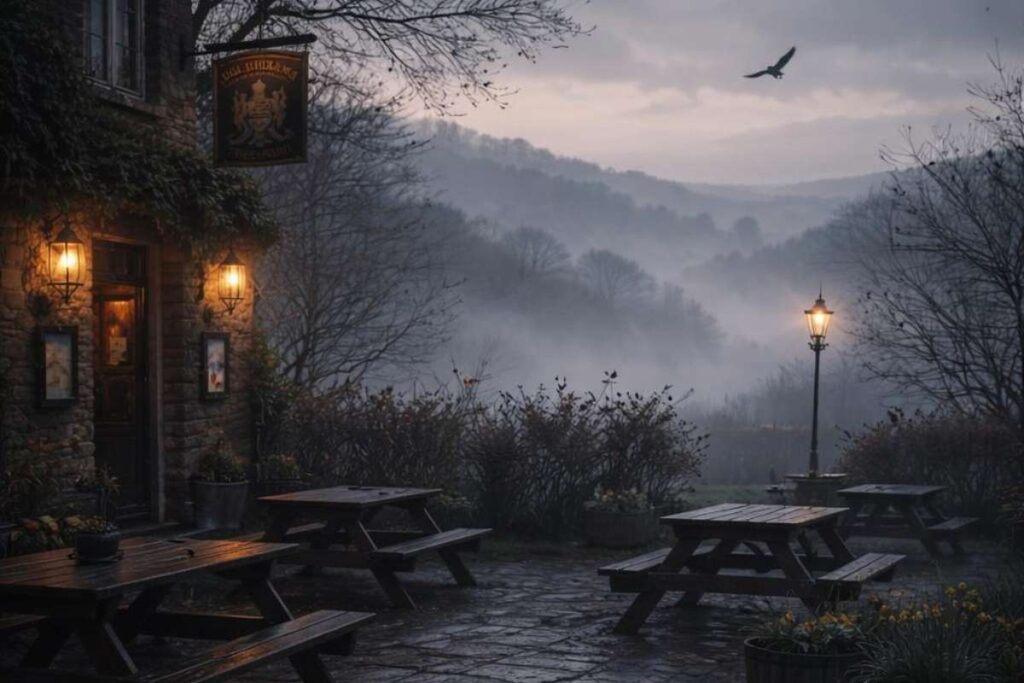
There’s a hill in Shropshire that a giant built by accident.
That’s the story, anyway. He was carrying a load of earth — stolen from Wales, as tends to happen in these accounts — with the intention of burying a town he’d taken a dislike to. A shoemaker talked him out of it. He dropped what he was carrying where he stood and walked away. The Wrekin has been there ever since.
There’s a second hill nearby. Two brothers, an argument about where to build a castle, a fight that went badly for one of them. He was buried under the stones they’d gathered. Left there.
You can still smell him, locals say, if the wind is right.
I find it telling that both stories end the same way. Not with a giant defeated, not with one driven off or slain. Just — put down. Settled into the earth. Still there, underneath, becoming something else.
That pattern repeats everywhere you care to look.
The folkloric record on giants is vast and oddly consistent for something that spans every continent and several thousand years of human storytelling.
The Fomorians of Irish myth — ancient, monstrous, pre-divine, connected to the land and the sea in ways that predate any god’s claim to either. They weren’t destroyed. They receded. The land remembers them.
The Norse frost giants didn’t live in some distant realm in the early accounts — they were the landscape. Ymir, the first giant, was killed by Odin and his brothers, and from his body they made the world. His flesh became the earth. His bones, the mountains. His blood, the seas. The world you’re standing on is a giant’s corpse, according to the Norse. They weren’t being poetic. They were being precise.
Wales gives you the Afanc, the buried thing in the lake. Gives you the giant astronomer whose chair is a mountain — Cadair Idris — and whose legend says that anyone who sleeps there wakes either mad or gifted with terrible sight.
In North America, the traditions run older and quieter. The Ojibwe speak of the Windigo as giant in some accounts — not the cannibal creature of later retellings, but something vast and cold and hungry in the way that winter is hungry. The Cherokee record a race of giants who inhabited the land before human settlement.
In Patagonia, Magellan’s crew recorded encounters with people of extraordinary stature in 1520. The accounts were dismissed as sailor’s exaggeration for centuries. Some still dismiss them.
In most cases, the giants are before. Before the current humans settled it. And they didn’t leave so much as descend. Into the ground. Into the rock. Into the long slow process of becoming landscape.
Very old things do not disappear simply because we stop believing in them.
They compress. They slow down. Their timescales become geological rather than biological. A breath that takes an hour. A heartbeat you’d measure in seasons.
Still alive. Just — deep.
Ellis Marsh put two people up the Wrekin on a bad day for weather and good intentions.
I won’t tell you what they found. That’s the story’s job, and Blood in the Hedgerows does it better than I would.
What I wrote in my note at the back of the book — and I’ll stand by it here — is that the giant is still there. And not only there.
The hills you drive past without looking. The long low ridges you’ve stopped seeing because they’ve always been in the background. The pressure you feel in valleys on still days, the smell that shouldn’t be there, the ground that shifts once and doesn’t shift again.
Everywhere.
Not dead. Not dormant, exactly.
Just on a different clock.
The folklore isn’t wrong. It’s just that the people who wrote it down were working from brief observations of something that moves too slowly for a human lifetime to track.
We’re the ones who got the timescale wrong. We looked at a mountain and saw something finished.
It was just between breaths.

To read the books mentioned in this post, go to: