Tuesday. The farm shop on the edge of the village. I need eggs. That’s the whole of it, as errands go.
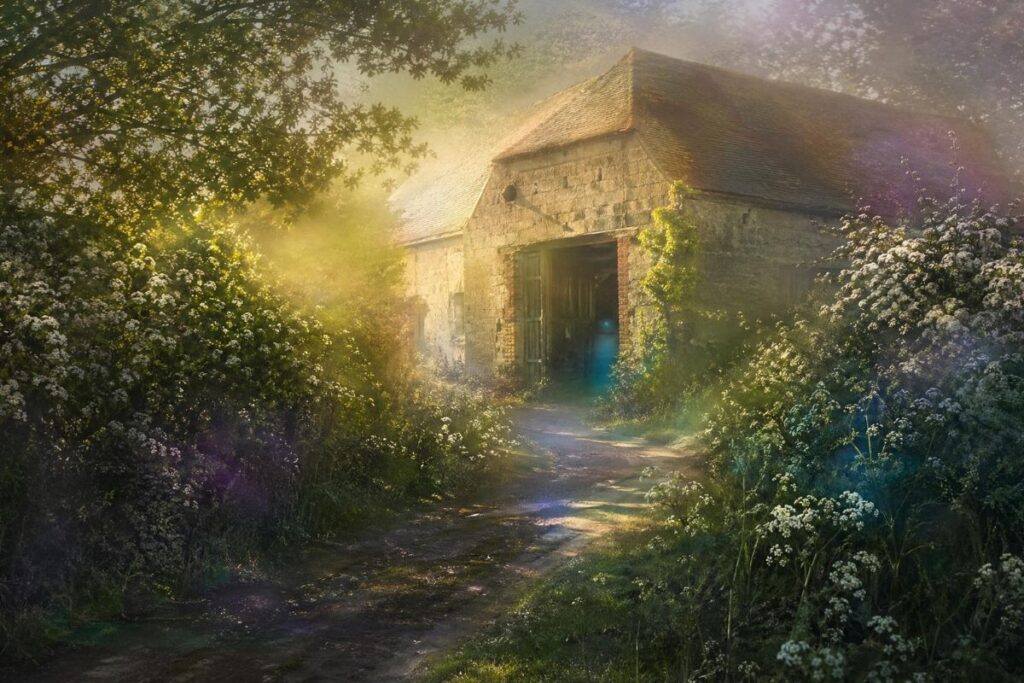
Late April and the lane is aggressive with green—hawthorn budding hard, cow parsley shouldering up through the verge, the whole hedgerow committed. The air above the fields is layered with it. A soft, breathing green that intermittently lifts and settles.
I don’t rush. The walk, whether in snow or sunshine, is refreshing.
The farm shop smells of cold stone and warm pastry. The woman behind the counter—third generation on this land (though she doesn’t know I know that)—is stacking tins. We nod. That’s the extent of our relationship and it suits us both.
I pick up eggs. A pork pie from the counter, still warm. Bread. Move past the basket of forced rhubarb. It hums a low copper haze—very certain of itself for something so early.
It’s important to read not just the colour, but the sound and movement, too. It drifts and layers, hums and sings, and occasionally it fires.
The language is one the world has been speaking since before anything walked upright and started giving things names. We read it automatically, the way you read a face.
Outside the shop, the air above the soil runs deep ochre threaded through with dull green, both of them moving slowly east, heavy and low, ankle-deep. An old drainage problem, never fixed. The ground sighing with it, still telling anyone who cares to look.
The timber frame above the entrance holds a faded purple that barely shifts. A colour that used to spread outward back when it was a tithe barn. The mature pride still purrs to mark itself.
The woman behind the counter: a warm steady brown that moves gently around her, slow and self-contained. At the edges, something unresolved—a thin thread of blue that reaches, occasionally, toward the door. To something or someone outside. A question she hasn’t asked yet.
I pay for the groceries. We talk about the weather.
When I can’t read it—when the language goes flat in a way that has nothing to do with the season—that’s when I slow down and give my attention.
A colour that should drift but stabs instead. A warmth that should be reaching, recoiling. A field in late April that gives nothing back when the air above every other field on the lane is shouting with green. Those are the signals. Something is wrong, or something is hidden, or something doesn’t want to be seen.
All three are worth knowing.
The colours tell you what a place is carrying. What a person wants. Whether a bird is lying to you. The sound and the movement give an extra layer. Allow you to go deep if you can be bothered.
And here’s the twist. Are you ready?
You’ve seen it.
The flash at the corner of your eye that you wrote off as tiredness, or the angle of the afternoon light, or shadows that are lit with an unusual hue.
It wasn’t your eyes playing tricks. It was real.
I get home. Put the eggs down. Cut a corner off the pie while it’s still warm enough.
Outside the window, the hawthorn is doing something extravagant with the morning light, greens and golds lifting off it in slow turns.
I watch it for a while.
Some things you just let speak, but you have to pay attention.

To read the books mentioned in this post, go to: